How to Validate Your OpenAPI Spec Before Generating Code
Validate your OpenAPI spec before generating SDKs or server stubs. Catch schema errors, missing refs, and invalid examples early so code generation does not fail later.
Published
Reading time
7 min read
Topics covered
Why read this
This guide helps teams avoid broken SDKs and failed generator runs by validating their OpenAPI contract before generating any code.
- Learn which OpenAPI mistakes usually break code generation workflows.
- See a fast validation workflow using ApiNotes before running generators.
- Compare ApiNotes with common alternatives for pre-codegen validation.
You generated a client SDK or server stub from your OpenAPI file, and the output either failed halfway through or produced code that clearly was not right. Maybe the generator could not resolve a $ref, maybe one schema used the wrong type, or maybe a response object looked valid at a glance but violated the OpenAPI version you were targeting. These problems usually do not start in the code generator. They start in the spec.
That is why validating your OpenAPI spec before generating code is the safer workflow. Instead of discovering contract issues after you have already produced broken TypeScript, Java, Python, or Go output, you validate the source document first, fix structural errors early, and only then hand the spec off to OpenAPI Generator, Swagger Codegen, or your preferred tool.
# Why Validation Should Come Before Code Generation
Code generators are strict because they have to be. They need a complete, internally consistent API contract before they can produce usable models, clients, and server interfaces. If your spec has unresolved references, invalid examples, malformed schemas, or version-specific incompatibilities, generators tend to fail in one of three ways:
- They stop with a cryptic error message
- They generate incomplete code with missing models or operations
- They generate code that compiles but behaves incorrectly
That last category is the most expensive. A generator failure is annoying, but silent bad output is worse because it creates false confidence.
Common pre-codegen issues include:
- Broken
$refpointers to schemas, parameters, or responses - Invalid request or response body structures
- Mismatched types such as
type: stringwith numeric examples - Missing required fields inside schema definitions
- Invalid
oneOf,anyOf, or discriminator usage - OpenAPI version mismatches between 3.0, 3.1, and Swagger 2.0
- Duplicate operation IDs that can break generated method names
If you validate first, you reduce the risk of debugging the wrong layer. You fix the contract instead of chasing side effects in generated code.
# The Fastest Workflow: Validate First with ApiNotes
If your target query is, "how can I validate an OpenAPI spec before generating code?", the shortest useful answer is this:
- Paste or upload your OpenAPI file into ApiNotes OpenAPI Validator
- Review the errors and warnings
- Fix the spec until it passes cleanly
- Then run your code generator
This works well because you can validate the same YAML or JSON file you plan to feed into your generator. You are not translating formats or introducing a second source of truth. You are checking the contract directly.
# Step 1: Paste or Upload the Spec
Open the ApiNotes OpenAPI Validator and either paste your YAML or JSON into the editor or upload the file directly from your machine. ApiNotes supports OpenAPI 3.0, OpenAPI 3.1, and Swagger 2.0, so it fits most code generation workflows.
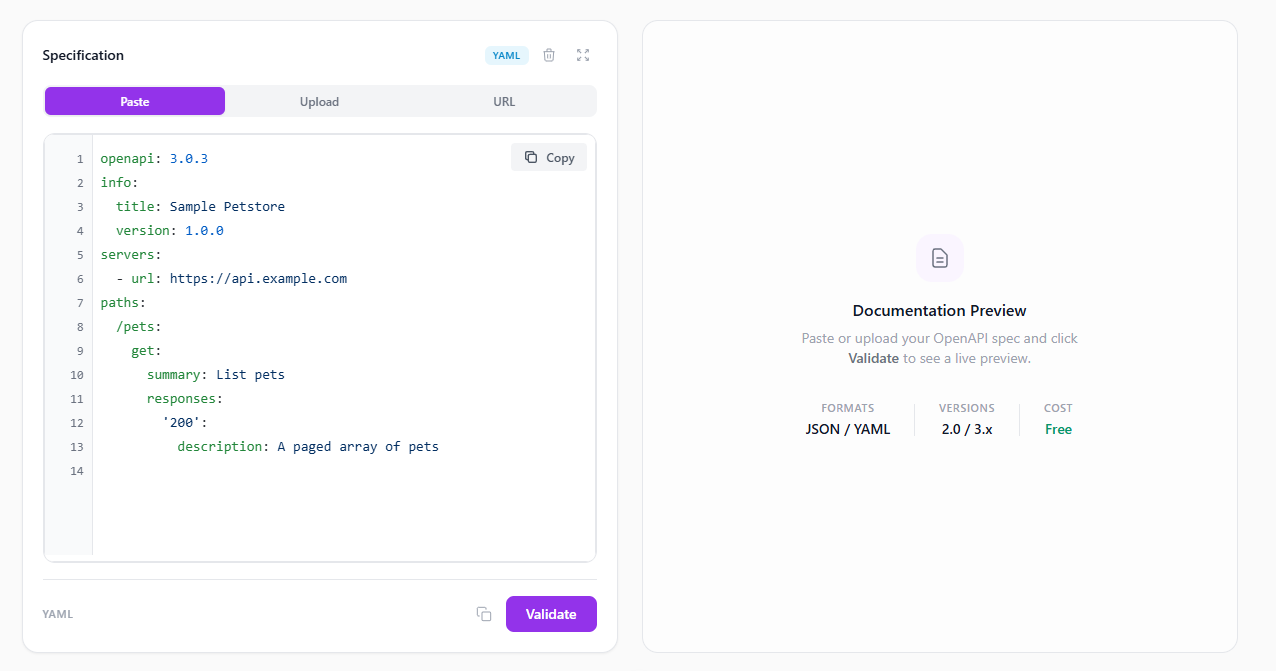
This is the point where many teams would normally jump straight into OpenAPI Generator. Instead, you pause and validate first.
# Step 2: Review Validation Errors Before They Hit Codegen
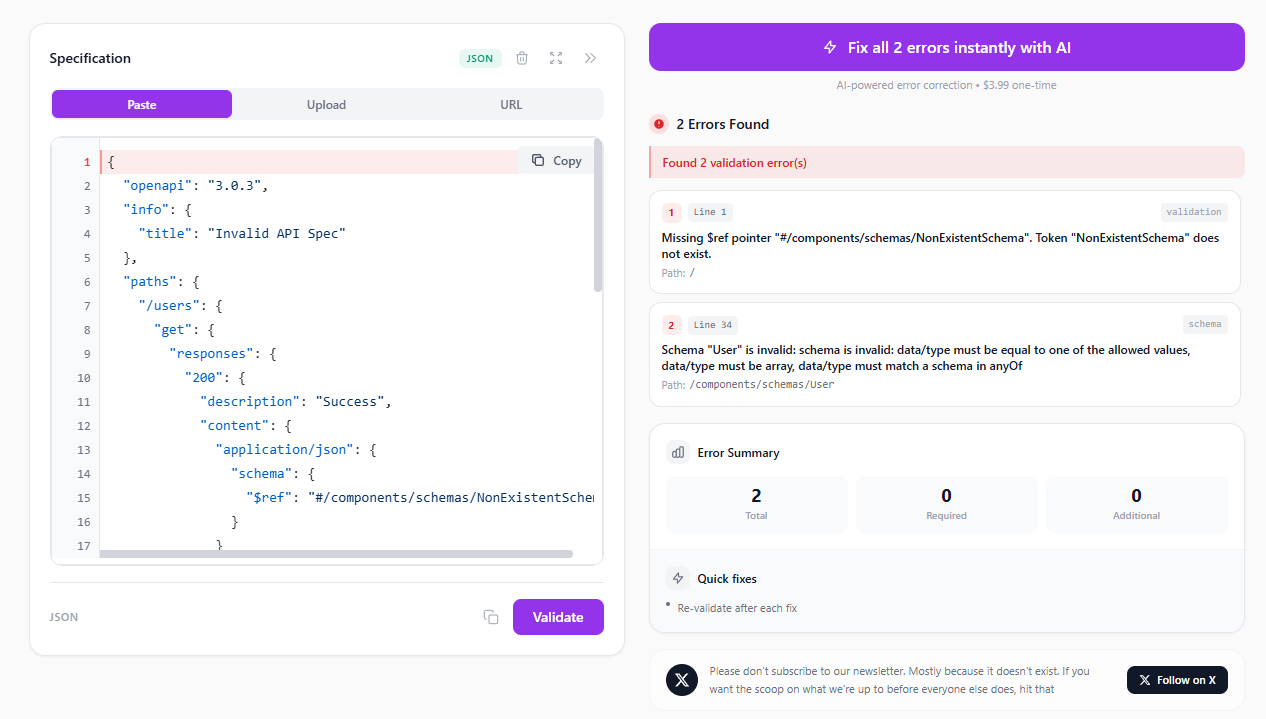
Once the spec is loaded, ApiNotes parses the document and highlights structural issues. That includes format problems, schema issues, and contract-level mistakes that commonly break downstream tooling.
The value here is not just that you get an error. It is that you get the error before code generation adds more noise. You can focus on fixing the source document while the scope is still small.
Typical issues you can catch at this stage:
- A path item references a schema that does not exist
- A response schema uses invalid nesting or unsupported fields
- A parameter is declared incorrectly for its location
- An example payload does not match the declared schema
- A schema object mixes version-specific features in a way that breaks generators
# Step 3: Fix the Spec and Re-Validate
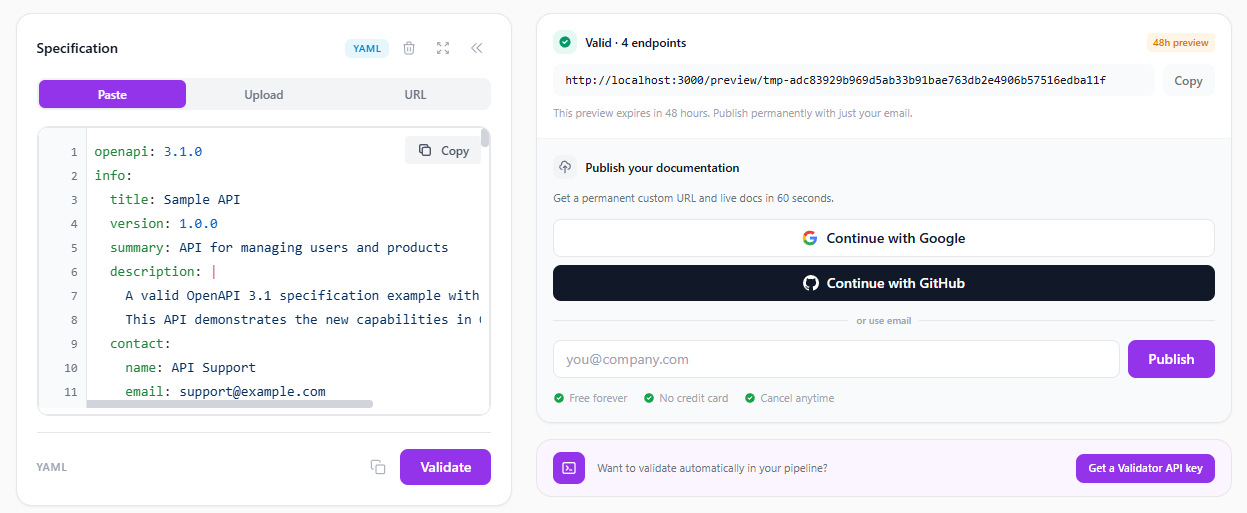
Validation should be iterative. Fix the issue, run validation again, and repeat until the document passes cleanly. This is much faster than generating code on every change and hoping the next run works.
At this point, you are not trying to polish documentation or produce a mock server. You are making sure the contract is structurally sound enough for automation. That is the real pre-codegen gate.
# Step 4: Generate Code Only After the Spec Passes
Once the spec validates, feed the same file into your generator of choice. That could be OpenAPI Generator, Swagger Codegen, NSwag, or another ecosystem-specific tool.
The practical benefit is simple: when code generation fails after validation, you now know the problem is more likely generator configuration, target language quirks, template behavior, or custom settings. You have already eliminated the obvious contract errors.
# What to Check Before You Generate Code
Even if your validator says the file is broadly valid, there are a few areas worth reviewing because they have an outsized effect on generated output.
# 1. Operation IDs
Many generators turn operationId values directly into method names. If they are duplicated, vague, or inconsistent, your SDK gets ugly fast. Use unique, stable, descriptive operation IDs.
Bad example:
operationId: getData
Better example:
operationId: listInvoices
# 2. Schema Reuse and $ref Consistency
Inline schemas are valid, but they often produce weaker generated models than reusable components. If the same object appears in multiple places, put it in components/schemas and reference it consistently.
This improves generator output in three ways:
- Cleaner model names
- Less duplicate generated code
- Easier future maintenance
# 3. Required Fields and Nullable Behavior
Generated clients depend heavily on whether a field is required, optional, or nullable. If this part of the contract is sloppy, the generated types will be sloppy too.
That is especially important in TypeScript, Kotlin, and C# where optionality and nullability materially change how developers consume the SDK.
# 4. Examples That Match the Schema
Examples are not only for documentation. Many teams use them during testing, mock generation, and review. If the example payloads do not match the schema, it is a warning sign that the contract itself is drifting.
# 5. OpenAPI Version Compatibility
Some generators lag behind the latest spec features. A document may be valid OpenAPI 3.1 and still require care depending on the codegen toolchain you plan to use. Validating first helps confirm whether the spec itself is sound before you troubleshoot generator support.
# Why ApiNotes Fits This Workflow
ApiNotes is a practical front door for this task because it combines fast validation with a readable interface and immediate feedback. You do not need to install anything just to answer a basic question like, "Is this spec valid enough to generate code from?"
That matters when:
- You are reviewing a spec from another team
- You are debugging a failed CI codegen job
- You are preparing a spec before generating a new SDK
- You want a quick pre-commit or pre-release validation pass
It also keeps the workflow simple: validate the contract, then move on to generation only after the contract is clean.
# Try It Now
If you want to catch spec issues before they turn into broken generated code, validate the file first.
No setup, no install, and no need to wait until OpenAPI Generator fails to find out your spec has problems.
# ApiNotes vs Alternatives for Pre-Codegen Validation
If your only goal is to validate an OpenAPI spec before generating code, here is how ApiNotes compares with common alternatives:
| Option | Best for | Setup required | Validation feedback | Good before code generation | Tradeoffs |
|---|---|---|---|---|---|
| ApiNotes | Fast browser-based validation before codegen | None | Clear, immediate, UI-driven | ✅ Yes | Less customizable than a fully scripted local pipeline |
| Swagger Editor | Editing and validating specs in browser | Low | Good editor-based feedback | ✅ Yes | More editing-oriented than workflow-oriented |
| Redocly CLI | Teams that want linting in CI/CD | Medium | Strong terminal output and rulesets | ✅ Yes | Requires install and config |
| Spectral | Custom API governance and lint rules | Medium | Powerful rule-based linting | ✅ Yes | Best when you are ready to maintain rules |
| OpenAPI Generator only | Teams skipping dedicated validation | Low | Errors show up during generation | ⚠️ Sometimes | You find spec issues later and with noisier feedback |
| Swagger Codegen only | Legacy generation workflows | Low | Errors show up during generation | ⚠️ Sometimes | Same core problem: validation happens too late |